Sponsored article
Hand Painting and Stamping: What Gives Bolesławiec Pottery Its Individual Character?
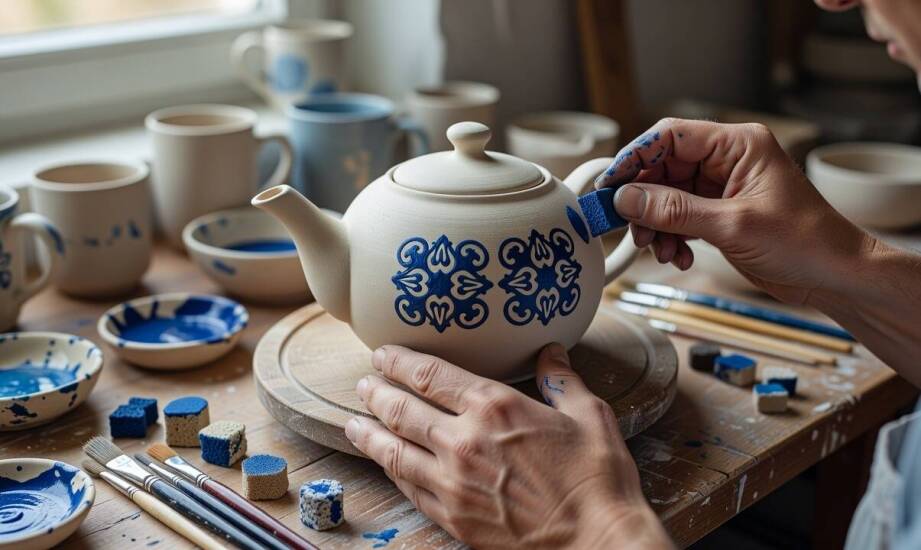
- The Rhythm of Stamping and the Freedom of Hand Painting
- Why Small Differences Are Part of the Character
- How Is the Decoration Applied?
- Why Does Cobalt Blue Play Such an Important Role?
- How Do Hand-Decorated Pieces Work Together as a Set?
- Hand Decoration and the Atmosphere of the Table
- Traditional Techniques in Contemporary Designs
- What Makes the Decoration Durable?
- Is Bolesławiec Pottery Food-Safe?
- Why Does Hand Decoration Add Emotional Value?
- Individuality Without Losing Consistency
- FAQ
- Why can two pieces with the same pattern look slightly different?
- Are small differences in decoration considered defects?
- How are Bolesławiec patterns applied?
- At what stage is the pottery decorated?
- Can hand-decorated Bolesławiec pottery be used every day?
- Why are cobalt patterns so strongly associated with Bolesławiec pottery?
Two mugs decorated with the classic peacock-eye motif can look almost identical when placed next to each other on a table.
Read more: How Polish ceramics win the hearts of connoisseurs around the world?
From a distance, they appear to belong to the same perfectly repeated series. A closer look, however, reveals small differences. On one mug, the cobalt pattern may be slightly more regular, while on the other the colour can appear deeper or the spacing between individual elements a little more dynamic.
These differences do not necessarily come from a different design.
They are a natural result of manual decoration.
Traditional stamping and hand painting mean that each piece passes through the hands of a decorator who controls the position, pressure and amount of coloured slip applied to the ceramic surface.
This is one of the reasons why Bolesławiec ceramics are valued not only as functional tableware but also as objects that preserve visible traces of craftsmanship.
The Rhythm of Stamping and the Freedom of Hand Painting
One of the characteristic methods used in Bolesławiec pottery is stamping.
At Bunzlau Manufaktura, decorators use stamps dipped in coloured clay slip to create repeated motifs such as:
peacock eyes;
dots;
rosettes;
leaves;
floral patterns;
geometric arrangements.
The decorator places each element by hand.
Even when the same pattern is repeated hundreds of times, the final result is not completely identical from one piece to another.
The amount of coloured slip transferred by the stamp, the pressure used and the position of each impression can create subtle differences in intensity and spacing.
Hand painting with brushes provides even greater freedom.
It can be used to add fine details, outlines, leaves and floral elements that would be difficult to achieve with stamping alone.
Combining both techniques creates an interesting balance between rhythm and individuality.
The final density and appearance of the decoration depend on the decorator's movements, the amount of colour applied and the way individual elements are arranged.
This makes hand-decorated pottery visually different from mechanically printed tableware, where every motif is reproduced in exactly the same position.
Why Small Differences Are Part of the Character
Customers used to industrially produced tableware may initially notice small irregularities in hand-decorated ceramics.
A dot may be slightly darker.
A floral element can sit a few millimetres differently.
One stamped motif may contain slightly more pigment than the next.
In handcrafted pottery, these variations are not automatically defects.
They are often evidence that the decoration was applied individually rather than printed by machine.
Bunzlau Manufaktura itself emphasises that no two hand-decorated cups are completely identical and that small differences are part of the handcrafted nature of the product.
For people looking for authentic boleslawiec poland pottery, this individual character can become an important part of the appeal.
A collection built over time may therefore remain visually coherent while still containing small differences between individual pieces.
How Is the Decoration Applied?
The production process involves several stages.
According to Bunzlau Manufaktura, ceramic cups begin with local clay, which is shaped and dried before undergoing an initial firing at approximately 900°C.
Only after this stage are the decorations applied.
Patterns are added by hand using stamps dipped in coloured clay slips and, depending on the design, brushes.
After decorating, the piece is covered with a transparent glaze and fired again at approximately 1250°C.
This sequence is important.
The decoration is not simply printed onto the finished surface.
It becomes part of the glazed ceramic during the firing process.
As a result, the pattern is visually integrated with the vessel rather than sitting on top of it like a conventional surface print.
Why Does Cobalt Blue Play Such an Important Role?
Deep cobalt blue is one of the colours most strongly associated with traditional Bolesławiec pottery.
It appears in classic motifs such as:
peacock eyes;
concentric circles;
dots;
decorative bands.
Modern collections also use other colours, including green, red, brown and yellow.
This allows traditional techniques to be applied to both classic and more contemporary designs.
The result is that Bolesławiec ceramics can work in interiors that range from rustic and traditional to modern and minimalist.
How Do Hand-Decorated Pieces Work Together as a Set?
One of the advantages of handmade tableware is that a collection does not need to be perfectly identical in order to look coherent.
Pieces can share:
the same colour palette;
the same decorative motif;
a similar rhythm of stamped elements;
related shapes.
At the same time, small differences between individual items prevent the set from looking mechanically uniform.
This can be particularly attractive when building a collection gradually.
A person may begin with one mug, then later add a bowl, plate, teapot or serving piece.
Because the patterns are related rather than mechanically identical, the collection can develop naturally over time.
Choosing individual ceramic cups can therefore be a simple way to introduce Bolesławiec craftsmanship into everyday table settings.
Hand Decoration and the Atmosphere of the Table
The decoration technique influences more than the appearance of a single object.
It also changes the overall impression of a table setting.
Dense, rhythmic stamped patterns can create a more traditional and ordered composition.
More fluid floral elements can make the arrangement feel lighter and more informal.
Combining different designs within the same colour family can produce a table that looks coordinated without becoming overly uniform.
This is one of the reasons handmade ceramics work well both as complete tableware sets and as individual accent pieces.
Traditional Techniques in Contemporary Designs
Bunzlau Manufaktura combines traditional decoration methods with new patterns and contemporary product forms.
The company continues to use its characteristic stamping technique while also developing designs created by collaborating artists.
This means that traditional production methods do not limit the pottery to historical motifs.
The same technique can be used to create:
classic cobalt decorations;
floral compositions;
geometric patterns;
modern interpretations of regional designs.
The identity of Bolesławiec pottery therefore comes not only from one specific motif but also from the method used to create it.
What Makes the Decoration Durable?
Hand decoration would have little practical value if it could not withstand regular use.
The final firing plays an important role in combining aesthetics with everyday functionality.
After decoration, Bunzlau Manufaktura covers the piece with transparent glaze and fires it at around 1250°C.
The manufacturer states that the resulting decoration is resistant to normal use and that its ceramic cups and selected other products can be washed in a dishwasher and used in a microwave.
The glaze also creates a smooth surface that protects the decoration underneath.
For users, this means that the traditional appearance does not require the pottery to be treated purely as a decorative object.
It can remain part of everyday kitchen and dining routines.
Is Bolesławiec Pottery Food-Safe?
When discussing ceramic tableware, it is better to rely on the manufacturer's declared material and glaze properties than on broad claims about individual pigments.
Bunzlau Manufaktura states that the glazes used for its cups are lead-free, while its cookware range is described as using glazes free from lead and cadmium.
This is more meaningful from a consumer perspective than claiming that a particular cobalt-based pigment can never react with food under any circumstances.
The finished, glazed vessel should be assessed as a complete product.
Why Does Hand Decoration Add Emotional Value?
The appeal of handmade pottery is not limited to its technical characteristics.
A hand-decorated mug or bowl also records part of the production process in its final appearance.
Small variations reveal that someone physically placed each decorative element rather than simply pressing a button to reproduce a digital image.
This gives everyday objects a more personal character.
A cup used every morning can become familiar not only because of its shape but also because its pattern is slightly different from every other piece in the cupboard.
For gifts, this can be especially meaningful.
Even when two people receive items from the same collection, their pieces may contain small individual variations created during decoration.
Individuality Without Losing Consistency
The distinctive character of Bolesławiec ceramics comes from the balance between repetition and variation.
The same pattern can be recognised immediately.
The same cobalt colour can appear across an entire collection.
The same stamping technique can be used on different shapes.
Yet the manual process means that individual pieces are not exact copies.
That combination of recognisable design and subtle variation is one of the defining qualities of hand-decorated Bolesławiec pottery.
It allows traditional craftsmanship to remain visible in objects designed for everyday use.
Hand stamping and painting create subtle differences in colour intensity and pattern placement.
Small variations between pieces are a natural result of manual decoration.
Bunzlau Manufaktura uses stamps, coloured clay slips and brushes to create its patterns.
Pieces are initially fired at around 900°C, decorated and glazed, then fired again at around 1250°C.
The final glaze protects the decoration and supports everyday use.
The manufacturer declares its cups dishwasher- and microwave-safe.
Traditional decoration techniques can be used for both classic and contemporary designs.
FAQ
Why can two pieces with the same pattern look slightly different?
Because the decoration is applied by hand. Differences in pressure, colour application and positioning can subtly change the appearance of individual stamped or painted elements.
Are small differences in decoration considered defects?
Not automatically. Minor variations are a natural characteristic of hand-decorated ceramics and can demonstrate that the piece was decorated individually rather than mechanically printed.
How are Bolesławiec patterns applied?
Bunzlau Manufaktura uses stamps dipped in coloured clay slips and, depending on the design, hand-painted details applied with brushes.
At what stage is the pottery decorated?
The manufacturer describes an initial firing at approximately 900°C, followed by decoration, transparent glazing and a second firing at around 1250°C.
Can hand-decorated Bolesławiec pottery be used every day?
Yes. Bunzlau Manufaktura states that its ceramic cups and many other products are suitable for dishwasher and microwave use. Care instructions for the specific product should still be followed.
Why are cobalt patterns so strongly associated with Bolesławiec pottery?
Cobalt blue has become one of the most recognisable colours used in traditional Bolesławiec designs, including peacock-eye motifs, dots and decorative bands.
You might be interested

The Future of Coffee Roasting Machines: What Awaits Us?

New or Used Amusement Machines for FECs: What Really Determines Profitability?

Whole Pork Snouts as a Raw Material for Sorting, Portioning and Further Processing